
Endometriosis changes your body and sometimes your menstrual cycle. But your options remain. Here you’ll find reliable information and honest guidance on trying to conceive with endometriosis—expertly reviewed and based on a holistic approach.
The updated S2k guideline, “Diagnosis and Treatment of Endometriosis,” was published on June 16, 2025. It replaces the 2020 version and focuses on the quality of life of those affected.
The most important thing for you to know: Today, the diagnosis is primarily based on a detailed consultation, a thorough review of your pain history, and modern imaging techniques such as ultrasound and MRI. Laparoscopy is reserved for specific situations. For many women, this means a shorter, less invasive path to a clear diagnosis.
Another new development is that, before deciding on a treatment plan for endometriosis affecting the ovaries, doctors now measure anti-Müllerian hormone levels to assess your egg reserve and take your desire to have children into account from the very beginning.
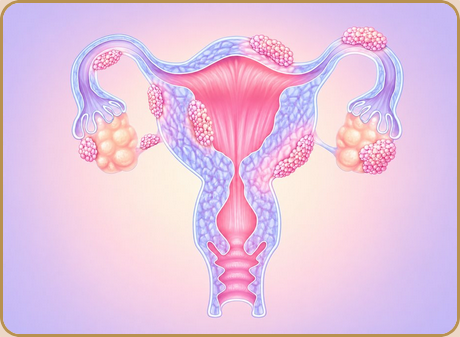
In endometriosis, tissue similar to the lining of the uterus grows outside the uterus—for example, on the peritoneum, the ovaries, the fallopian tubes, or the intestines. This tissue responds to your menstrual cycle and can cause inflammation, pain, and adhesions.
Endometriosis is one of the most common chronic conditions among women of childbearing age. Worldwide, it affects about one in ten women; in Germany, that figure is around two million women. Approximately 40,000 new cases are diagnosed each year.
Endometriosis manifests differently in every woman. Some experience severe pain during their period, while others have chronic lower abdominal pain, pain during intercourse, urination, or bowel movements. Some women have few symptoms and only learn of their diagnosis when they try to conceive. Because endometriosis presents in so many different ways, your specific situation deserves a personalized assessment rather than blanket assumptions.
On average, it still takes about seven and a half years from the onset of symptoms to diagnosis. The new guideline aims to shorten this timeframe by taking symptoms more seriously at an earlier stage and relying on minimally invasive imaging.
It’s a good idea to have a detailed discussion with your gynecologist or a specialist at an endometriosis center if you notice any of these symptoms:
A thorough pain history is now considered a key part of the diagnosis. The more accurately you document your symptoms, the clearer the picture. That’s exactly what MyBabyWish is designed for.
Many women with endometriosis are able to get pregnant. Endometriosis can make it difficult to conceive, for example due to adhesions, inflammation, or anatomical changes. At the same time, there are now clear, effective ways to support your efforts to have a baby.
The approach that’s right for you depends on your situation, including your age, medical history, egg reserve, and your own pace. You’ll make this decision together with a reproductive medicine specialist. It’s important to consider your desire to have children from the very beginning, so that every treatment plan supports that goal.
A targeted surgical procedure can remove endometriosis lesions, break up adhesions, and restore the natural anatomy. For many women who wish to have children, this is a proven first step.
In IVF or ICSI, the egg and sperm are brought together in the laboratory. This is a well-established method, especially when the fallopian tubes are affected.
If you ovulate regularly, keeping track of your cycle accurately will help you identify your fertile days with confidence.
If you have endometriosis affecting your ovaries, your treatment team will now assess your egg reserve using anti-Müllerian hormone levels before scheduling any procedure. This helps protect your ability to have children.
Endometriosis is an inflammatory condition. Many women find it helpful to adopt an anti-inflammatory lifestyle: eating plenty of vegetables and healthy fats, getting enough sleep, and engaging in gentle exercise such as yoga. Heat, pelvic floor exercises, and breathing exercises provide relief for many women during periods of severe pain.
At your own pace, every small, steady step takes you further than a strict regimen.
Dealing with endometriosis while trying to conceive takes a toll. The new guidelines explicitly acknowledge this: they recommend targeted psychological support for women struggling to conceive, particularly cognitive-behavioral and mindfulness-based approaches. Studies show that psychological support during fertility treatment is associated with higher pregnancy rates.
This is exactly where MyBabyWish comes in. Licensed psychologist Gabriela Cueni and an experienced team are here to support you on days when you’re in pain, before and after medical exams, and during the weeks of waiting for answers.
MyBabyWish brings all your observations together in one place and offers you the opportunity to book consultations with experts who have hands-on experience with endometriosis.
Yes, many women with endometriosis do get pregnant. With proper care, close monitoring of their menstrual cycles, and medical support when needed—such as surgery or fertility treatment—pregnancy is well within reach for many women.
The new guideline emphasizes a thorough consultation, a detailed pain history, and modern imaging using ultrasound and MRI. Laparoscopy is reserved for specific situations. For many women, this approach provides clarity more quickly and with less invasiveness.
That depends on your medical findings, your age, and your egg reserve. Common approaches include surgical treatment to restore the anatomy, as well as fertility treatments such as IVF or ICSI. Your treatment team will plan your care in a way that protects your ability to have children.
It plays a major role. The guidelines recommend psychological support for those hoping to conceive, as it helps alleviate stress and is associated with higher pregnancy rates. MyBabyWish is there to support you during these very moments.
Yes. You can keep track of your cycle and pain symptoms in one place and ask your questions directly to experienced professionals.
This page provides general information to supplement medical advice, diagnosis, and treatment. If you have symptoms, your doctor or an endometriosis center will assist you.
10-minute free initial consultation. Community chat. Cycle tracking. All in one app.